
SEO vs AI SEO: What Is the Difference and Which One Does Your Business Need?
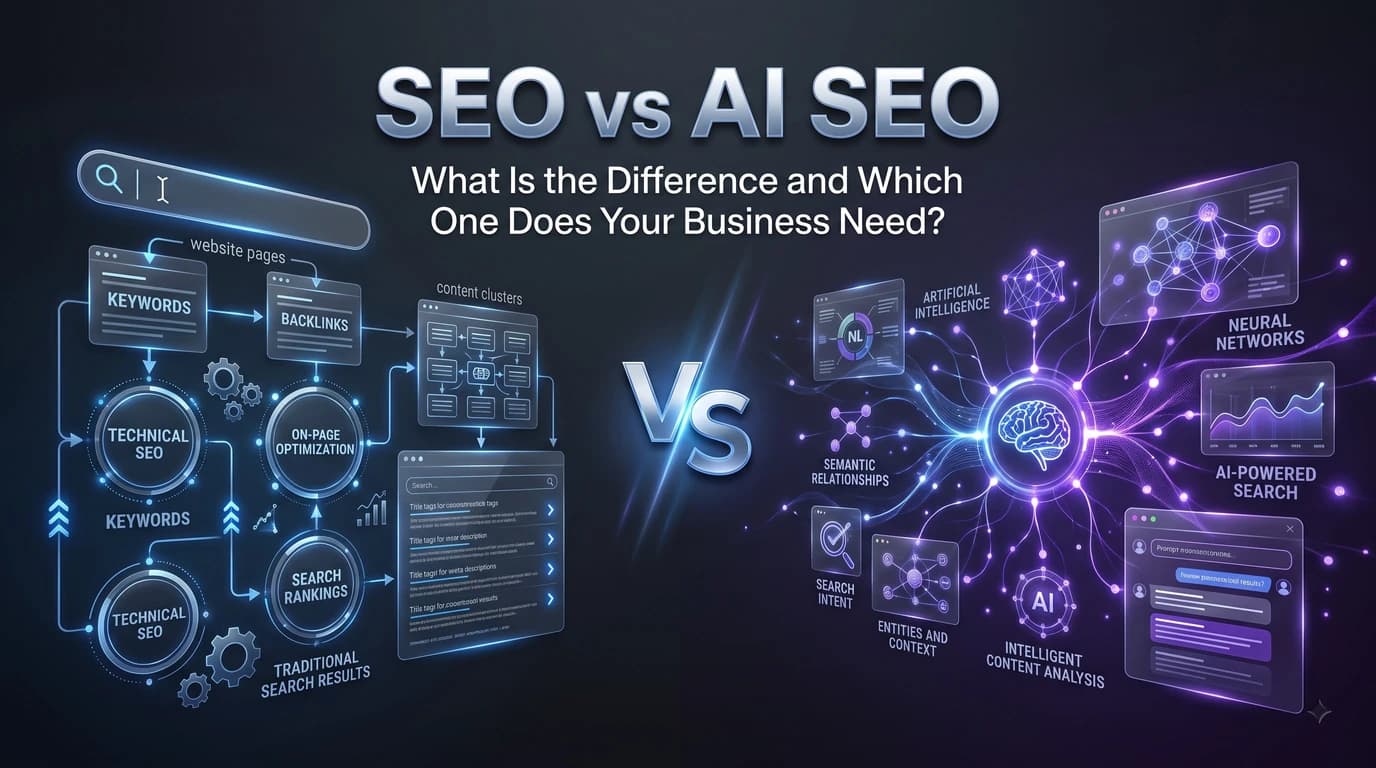
SEO vs AI SEO: What Is the Difference and Which One Does Your Business Need?
Search is changing quickly. Businesses that once focused only on keywords, backlinks, and traditional Google rankings now also need to understand artificial intelligence, search intent, topic relationships, and AI-powered search experiences.
This has created an important question for business owners and marketers: SEO vs AI SEO — what is the difference, and which one does your business actually need?
The good news is that you usually do not have to choose one and ignore the other. Traditional SEO provides the foundation for organic visibility, while AI SEO can make research, analysis, content optimisation, and SEO workflows more efficient.
In this guide, we will explain the difference between SEO and AI SEO, how both approaches work, their benefits, and how to decide which strategy is right for your business.
What Is SEO?
SEO, or Search Engine Optimization, is the process of improving a website so that search engines can understand its pages and users can find relevant information through organic search.
Traditional SEO commonly includes:
- Keyword research
- Search intent analysis
- On-page SEO
- Technical SEO
- Content optimisation
- Internal linking
- Link building
- Local SEO
- Website structure
- Performance optimisation
The objective is not simply to rank for keywords. A good SEO strategy helps a website become more useful, accessible, trustworthy, and relevant to the searches that matter to the business.
For example, a web development company might target searches such as "website development company," "ecommerce website development," or "website redesign services." Each search can have a different intent, so the corresponding page needs to answer the user's actual requirement.
What Is AI SEO?
AI SEO uses artificial intelligence, machine learning, automation, and data analysis to improve different parts of the SEO process.
Instead of relying entirely on manual research, SEO professionals can use AI to process larger amounts of information and identify patterns more efficiently.
AI SEO can help with:
- Keyword and topic discovery
- Search intent analysis
- Content gap research
- Competitor analysis
- Topic clustering
- Content optimisation
- Internal linking opportunities
- Technical SEO analysis
- Entity and topic mapping
- Content planning
- AI-search visibility
The important point is that AI SEO is not simply AI-generated content.
A proper AI SEO strategy combines technology with human expertise, editorial review, business knowledge, and SEO strategy. Webamazee's own AI SEO approach, for example, combines AI-driven topic and intent analysis with expert review, content optimisation, schema, and zero-click search optimisation.
If you want to understand the concept in more detail, you can also read this complete AI SEO guide for 2026.
SEO vs AI SEO: What Is the Difference?
Traditional SEO and AI SEO have the same overall goal: improving a business's visibility in search.
The main difference is how research, analysis, optimisation, and execution are performed.
| Traditional SEO | AI SEO |
|---|---|
| Manual keyword research | AI-assisted keyword and topic discovery |
| Manual competitor analysis | AI-assisted competitor pattern analysis |
| Individual content analysis | Large-scale content analysis |
| Manual content optimisation | AI-assisted content optimisation |
| Manual opportunity discovery | AI-assisted opportunity discovery |
| Traditional search focus | Traditional search + AI search opportunities |
| Fixed workflows | More data-driven workflows |
AI SEO does not make traditional SEO unnecessary. Instead, it can make many SEO processes faster and more scalable.
Why Traditional SEO Still Matters
AI may be changing search, but the basic requirements of a good website have not disappeared.
A business still needs:
- A technically healthy website
- Clear website architecture
- Useful content
- Relevant pages
- Good internal linking
- Strong user experience
- Search-intent alignment
- Trustworthy information
- Quality backlinks and mentions where appropriate
AI cannot fix every SEO problem.
For example, if a website has serious indexing issues, poor navigation, duplicate pages, or a weak content structure, simply generating more AI-assisted articles will not solve the underlying problem.
That is why SEO fundamentals should come first.
How AI SEO Improves Traditional SEO
AI can make traditional SEO processes more efficient without removing the need for human strategy.
1. AI-Powered Keyword Research
Traditional keyword research can produce a list of keywords. AI can help take that research further by grouping keywords according to topic, intent, relevance, funnel stage, and business value.
For example, a business targeting "SEO services" could discover related topics such as technical SEO, local SEO, ecommerce SEO, SEO audits, SEO pricing, and SEO strategy.
This creates a more complete content strategy instead of focusing on one keyword at a time.
2. Search Intent Analysis
Ranking for a keyword is not enough.
A page must satisfy the reason behind the search.
AI can help identify whether a search is:
- Informational
- Commercial
- Transactional
- Navigational
For example, someone searching "what is technical SEO" is probably looking for educational information.
Someone searching "technical SEO services" is more likely to be comparing service providers.
Understanding this difference helps businesses create the right page for the right audience.
3. Competitor Analysis
Competitor research is an important part of SEO.
AI can help analyse competitors at scale and identify:
- Content gaps
- Important topics
- Keyword opportunities
- Page structures
- Internal linking patterns
- Search intent
- Areas of stronger topical coverage
The objective should not be copying competitors.
Instead, businesses should identify opportunities where they can create more useful, original, and relevant content.
4. Content Optimisation
AI can review existing content and identify opportunities to improve:
- Topic coverage
- Headings
- Search intent alignment
- Readability
- Related topics
- Internal links
- Content structure
- Missing information
However, human review remains important.
AI should help improve content, not replace expertise.
5. Technical SEO Analysis
Technical SEO becomes more complicated as websites grow.
Large websites can have hundreds or thousands of URLs, making manual analysis difficult.
AI-assisted systems can help identify patterns involving:
- Broken links
- Missing metadata
- Indexing problems
- Duplicate content
- Redirect issues
- Poor page structures
- Crawlability problems
- Internal linking gaps
Technical decisions should still be reviewed by an experienced SEO professional.
Is AI SEO Better Than Traditional SEO?
There is no simple "yes" or "no" answer.
It depends on the business.
A small local business with a relatively simple website may not need a highly advanced AI SEO workflow.
A large ecommerce website with thousands of products may benefit significantly from AI-assisted analysis and optimisation.
Similarly, a SaaS company competing for hundreds of search topics may use AI to organise keyword research, content clusters, competitors, and search intent more efficiently.
The best approach is often:
Traditional SEO foundation + AI-powered research and optimisation + human expertise.
Which Businesses Can Benefit From AI SEO?
AI SEO can be particularly useful for businesses that need to manage large amounts of content or compete in highly competitive search markets.
Ecommerce Businesses
Online stores can have hundreds or thousands of product and category pages.
AI can help identify content gaps, product-related search intent, duplicate content issues, internal linking opportunities, and category optimisation opportunities.
SaaS Companies
SaaS businesses often need content covering different problems, features, comparisons, use cases, and buyer questions.
AI-assisted topic mapping can help organise these opportunities into logical content clusters.
B2B Companies
B2B buyers often perform extensive research before contacting a company.
AI SEO can help businesses understand the questions customers ask at different stages of the buying journey.
Local Businesses
Local businesses can use AI to identify location-specific search opportunities, customer questions, competitor content, and service-related topics.
Content-Heavy Websites
Websites with large content libraries can use AI-assisted analysis to identify outdated articles, content gaps, weak pages, and internal linking opportunities.
When Should You Focus on Traditional SEO?
Traditional SEO may be the right starting point if:
- Your website is relatively small
- You have a limited number of services
- You operate in a less competitive market
- You are just starting SEO
- Your website has technical problems
- You do not yet have a strong content foundation
In these situations, fixing the fundamentals should come before scaling with advanced AI workflows.
When Should You Consider AI SEO?
AI SEO becomes especially useful when:
- Your website is large
- You have hundreds of keywords
- Your competitors are publishing content faster
- You need to scale content research
- You operate in a competitive industry
- You want deeper search-intent analysis
- You need large-scale content optimisation
- You want to prepare for AI-driven search experiences
Webamazee's AI SEO service focuses on areas such as entity and topic mapping, intent analysis, AI content optimisation, schema, zero-click capture, and expert review.
SEO and AI Search: Are They the Same?
No.
AI SEO and AI search optimisation are related, but they are not exactly the same.
AI SEO generally means using artificial intelligence to improve SEO research, analysis, content optimisation, and workflows.
AI search optimisation focuses more on improving how a business's information can be understood and surfaced through AI-powered search experiences.
Both are becoming relevant as search behaviour becomes more conversational.
Instead of searching only for short keywords, users may ask detailed questions and expect search engines or AI systems to provide direct answers.
This makes clear, useful, well-structured, and authoritative information increasingly important.
Should You Use AI to Create SEO Content?
AI can be useful for content creation, but it should not be treated as a shortcut to publishing hundreds of pages.
A better workflow is:
Research → AI assistance → Human expertise → Fact-checking → Editing → SEO optimisation → Publishing → Measurement
The goal should be better content, not simply more content.
Content should provide genuine value, include accurate information, reflect the brand's expertise, and satisfy the user's search intent.
Common AI SEO Mistakes to Avoid
Publishing AI Content Without Review
AI-generated text can contain errors, generic explanations, or information that does not fully answer the user's question.
Important content should be reviewed and fact-checked.
Creating Too Many Low-Value Pages
Publishing more pages does not automatically increase organic traffic.
A smaller collection of genuinely useful pages can be more valuable than hundreds of repetitive articles.
Ignoring Technical SEO
Good content cannot compensate for serious technical problems.
Website structure, crawling, indexing, performance, mobile usability, and internal linking still matter.
Focusing Only on Keywords
Modern SEO requires more than repeating a target keyword.
Search intent, topical relevance, context, expertise, and usefulness all matter.
Automating Every Decision
AI is excellent for analysis and efficiency, but strategy still requires human judgment.
Business priorities, brand positioning, content quality, and editorial decisions should not be completely automated.
How to Choose Between SEO and AI SEO
Before choosing a strategy, look at your current website and business goals.
Ask:
How large is my website?
A small website may need a simpler strategy. A large website can benefit from scalable AI-assisted analysis.
How competitive is my industry?
Highly competitive industries often require deeper research and faster optimisation.
How much content do I need?
If your strategy requires hundreds of topics, AI can help organise and analyse them more efficiently.
Does my website have technical problems?
If yes, fix those issues before focusing heavily on content scaling.
Do I have experts reviewing the work?
AI should support human expertise rather than replace it.
If you are unsure where your website currently stands, you can start with a free SEO audit to identify potential technical, content, and optimisation opportunities.
SEO + AI SEO: The Best Approach for Many Businesses
Instead of thinking about SEO and AI SEO as competing strategies, businesses should consider how the two can work together.
A practical approach can look like this:
Step 1: Build a Strong SEO Foundation
Fix technical issues, improve website architecture, optimise important pages, and make sure search engines can properly access your website.
Step 2: Understand Search Intent
Research what your audience wants and why they are searching.
Step 3: Build Topic Clusters
Connect related topics and create useful supporting content around important services and products.
Step 4: Use AI for Research and Analysis
Use AI to process data, identify content gaps, analyse intent, and discover optimisation opportunities.
Step 5: Add Human Expertise
Review, fact-check, edit, and improve the content before publishing.
Step 6: Optimise and Measure
Track organic traffic, rankings, leads, conversions, and content performance.
For businesses looking for a broader search strategy covering technical SEO, on-page optimisation, content, and other core SEO activities, Webamazee's SEO services can provide the traditional SEO foundation that works alongside AI-powered optimisation.
Final Thoughts
So, SEO vs AI SEO: which one does your business need?
For most businesses, the answer is not one or the other.
Traditional SEO remains the foundation of organic search visibility, while AI SEO can make research, analysis, content optimisation, and large-scale SEO workflows more efficient.
If you have a small website, start with strong SEO fundamentals.
If you have a large website, a competitive market, or a growing content strategy, AI-assisted SEO can help you scale your efforts and identify opportunities more efficiently.
The most effective strategy is to combine SEO fundamentals, AI-powered analysis, quality content, and human expertise.
For businesses that want to adapt to the changing search landscape while maintaining a strong SEO foundation, Webamazee provides SEO and AI-powered optimisation strategies designed around search intent, content quality, technical performance, and modern search visibility.
Written by
Webamazee Team
Digital Marketing Expert at Webamazee. Webamazee Team helps businesses grow with a blend of data, AI and proven strategy.