AEO vs GEO vs SEO: What’s the Difference in 2026?
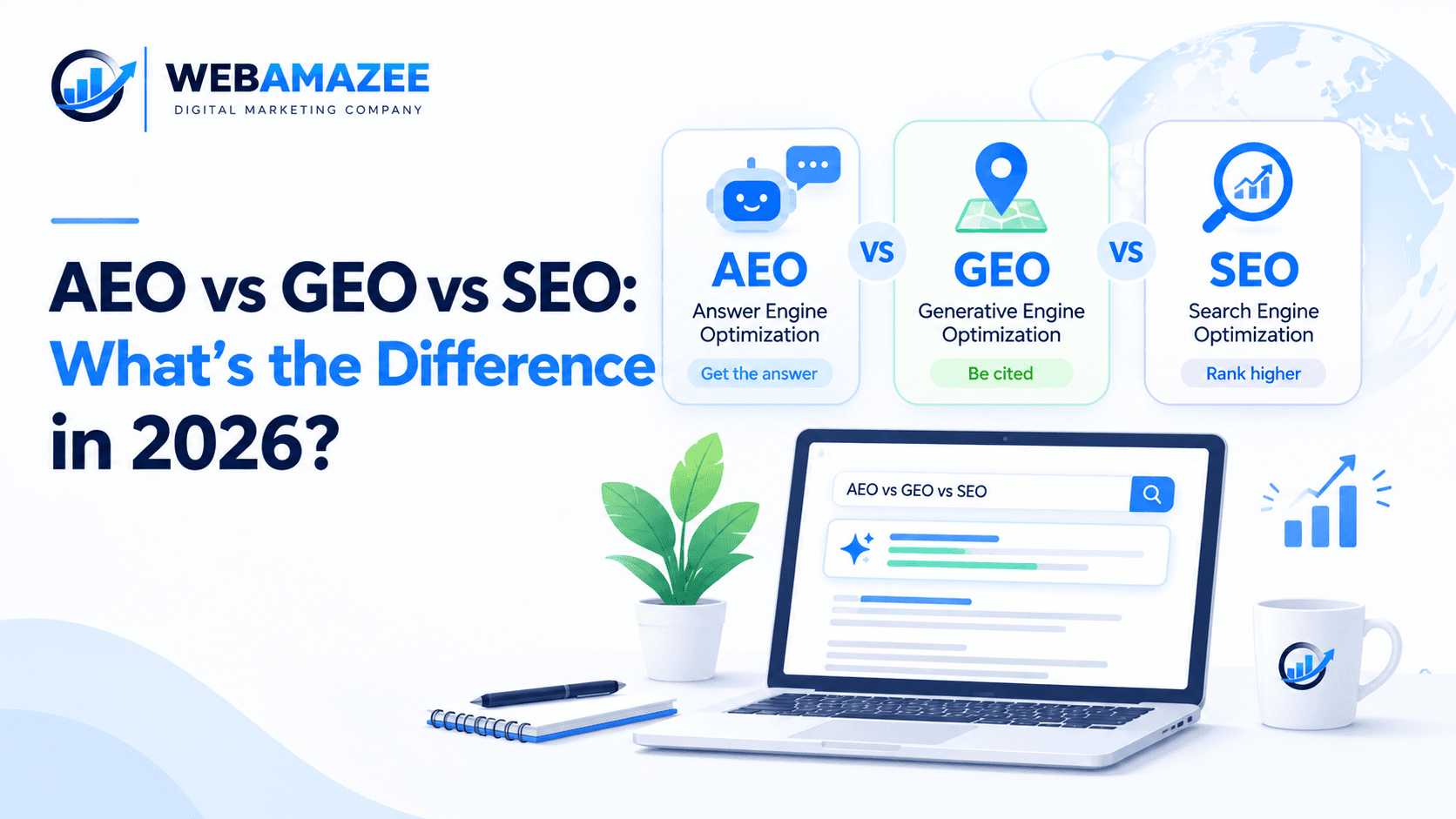
AEO vs GEO vs SEO: What’s the Difference in 2026?
Search is changing quickly. People are no longer using Google only to find a list of website links. They are also asking questions in AI-powered search experiences and looking for direct answers.
This has made terms like SEO, AEO, and GEO more common in digital marketing.
But what do these terms actually mean? Are AEO and GEO different from SEO? Do businesses need all three in 2026?
The simple answer is that SEO is still the foundation, while AEO and GEO focus more on how your content can appear in direct answers and AI-generated search results.
Google also confirms that its AI search features continue to rely on core SEO and Search systems.
What Is SEO?
SEO stands for Search Engine Optimization.
SEO is the process of improving a website so that it can appear higher in search engine results for relevant searches.
A good SEO strategy can include:
- Keyword research
- Helpful website content
- Technical SEO
- Internal linking
- Website speed and performance
- Mobile-friendly design
- Backlinks and brand mentions
- Clear website structure
- Search-friendly URLs
The main goal of SEO is to help search engines understand your website and connect your pages with people searching for related information.
For example, if someone searches for “best SEO company in Chandigarh,” an SEO strategy aims to help a relevant service page appear in the organic search results.
For businesses that want to improve their overall search visibility, SEO Services can provide the foundation for their online growth.
What Is AEO?
AEO stands for Answer Engine Optimization.
AEO focuses on making content easy for answer engines and search systems to understand and use when providing direct answers.
Instead of only trying to rank a page for a keyword, AEO focuses on questions people may ask.
For example:
Question: What is technical SEO?
A well-structured page can provide a short, clear answer before going into more detail.
AEO can involve:
- Answering common questions clearly
- Using useful headings
- Creating easy-to-understand content
- Providing direct answers
- Organizing information logically
- Using relevant structured data where appropriate
- Building strong topical coverage
The goal is to make your information useful and easy for search systems to understand.
What Is GEO?
GEO stands for Generative Engine Optimization.
GEO is generally used to describe efforts to improve a brand's visibility in generative AI experiences.
These experiences can include AI-powered search and conversational tools where users receive a generated answer instead of only seeing a traditional list of links.
For example, a user might ask:
“Which SEO companies can help a small business grow online?”
An AI system may generate an answer and mention different companies or websites.
GEO focuses on increasing the chances that a business, website, or piece of content is understood and considered a useful source.
It can involve:
- Creating useful and original content
- Building topical authority
- Strengthening brand information
- Earning trusted mentions
- Providing clear facts and answers
- Keeping important information updated
- Following strong SEO practices
AEO vs GEO vs SEO: The Main Difference
The three terms are closely connected, but their main focus can be explained simply.
| SEO | AEO | GEO |
|---|---|---|
| Focuses on search rankings | Focuses on direct answers | Focuses on generative AI visibility |
| Targets search engines | Targets answer-based search experiences | Targets generative AI experiences |
| Goal is often rankings and clicks | Goal is being used as a useful answer | Goal is being mentioned or cited in AI-generated answers |
| Uses technical SEO, content and links | Uses clear, answer-focused content | Uses strong content, authority and brand signals |
However, these should not be treated as three completely separate marketing systems.
Google's current guidance says that optimizing for generative AI search is still part of SEO. Its AI search features use Google's core Search systems to find relevant information.
AEO vs GEO: Are They Really Different?
This is where things can become confusing.
Different marketers use AEO and GEO in slightly different ways.
AEO usually focuses on being the answer, while GEO is often used for being included or cited in a generative AI response.
In real-world SEO work, there is a lot of overlap between them.
For example, creating a clear, useful article can help:
- Traditional Google rankings
- Direct-answer visibility
- AI-generated search experiences
- Users who want quick answers
So businesses usually don't need three completely different content strategies.
Instead, they should build a strong SEO foundation and create content that is useful for both people and modern search experiences.
SEO Is Still Important in 2026
There is a common idea that AI search means traditional SEO is no longer important.
That is not true.
Google's official guidance states that existing SEO best practices remain relevant for AI Overviews and AI Mode. Pages still need to meet Google's technical requirements and follow Search policies.
This means businesses should still focus on:
1. Technical SEO
Make sure search engines can crawl and understand your website.
This includes website structure, indexing, mobile usability, page experience, and other technical areas.
For websites that need greater technical improvements, Technical SEO should be part of the overall strategy.
2. Helpful Content
Create content that answers real questions instead of writing only to include keywords.
Google's 2026 guidance places strong importance on helpful, unique, and people-first content.
3. Internal Linking
Connect related pages naturally.
For example, an article about AI search can link to a relevant AI SEO service when it makes sense for the reader.
Internal links help users discover related information and help search engines understand the relationship between pages.
4. Strong Website Structure
Your website should have clear categories, useful navigation, and logical page relationships.
A well-organized website is easier for both users and search engines to understand.
5. Original Information
Don't simply rewrite what other websites have already published.
Add your own examples, experience, research, explanations or useful insights.
This can make your content more valuable than a basic copy of existing search results.
How to Optimize Your Website for SEO, AEO and GEO
You don't need three completely separate strategies.
Instead, build one strong content and SEO strategy that supports all three.
Step 1: Understand Your Audience
Find out what your customers actually search for.
Look for:
- Questions
- Problems
- Comparisons
- Services
- Product searches
- Local searches
- Buying-related searches
Step 2: Create Helpful Content
Write content that answers the user's question clearly.
Avoid unnecessary filler. Give the important answer first and then explain it in more detail.
Step 3: Cover a Topic Properly
Instead of creating many thin articles around slightly different keywords, build useful topic coverage.
For example, a website offering SEO services can create content around:
- SEO basics
- Technical SEO
- Local SEO
- AI SEO
- E-commerce SEO
- Content optimization
This creates a stronger connection between related pages.
Step 4: Use Clear Headings
Break long content into useful sections.
Use headings that match the questions people are likely to ask.
This makes the article easier to read and easier to understand.
Step 5: Keep Your Website Technically Healthy
Good content cannot perform well if search engines cannot properly access or understand your website.
Check:
- Indexing
- Crawlability
- Mobile experience
- Page speed
- Internal links
- Broken links
- Structured data
- Canonical URLs
Step 6: Build Real Authority
Publish useful content consistently and earn genuine mentions and links from relevant websites.
Avoid shortcuts or artificial tactics that are designed only to manipulate search systems.
Step 7: Track Your Results
Don't only look at keyword rankings.
Also monitor organic traffic, impressions, clicks and, where available, visibility in AI-powered search experiences.
Google introduced dedicated Search Console reporting for visibility in generative AI features, including AI Overviews and AI Mode.
Do You Need AEO or GEO in 2026?
Yes, but don't think of them as replacements for SEO.
The best approach is:
SEO → Build the foundation
AEO → Make answers clear and easy to understand
GEO → Improve visibility across generative AI experiences
The work overlaps heavily, so businesses should avoid creating completely separate strategies for each term.
SEO vs AEO vs GEO: Which One Should You Focus On?
For most businesses, SEO should come first.
Once your technical foundation, content and website structure are strong, you can improve your content for direct answers and AI-powered search experiences.
This is especially useful for businesses that want to be visible when potential customers ask detailed questions.
If your website needs a broader strategy, combining traditional SEO with AI SEO and content optimization can help create a more complete search visibility plan.
Final Thoughts
AEO, GEO, and SEO may sound like three different things, but they are closely connected.
SEO helps your website become visible in search. AEO focuses on providing clear answers. GEO focuses on visibility in generative AI experiences.
The important point for 2026 is that businesses should not abandon SEO.
Google's own guidance makes it clear that strong SEO fundamentals remain important for AI Overviews and AI Mode.
Instead of chasing every new SEO term or AI-search trick, focus on what matters most: a technically strong website, useful content, clear answers, real expertise, and a good experience for your audience.
That approach can help your website stay visible as search continues to change.
Frequently Asked Questions
Is AEO replacing SEO?
No. AEO is not a replacement for SEO. SEO remains the foundation for visibility in Google Search, including its AI-powered search features.
Is GEO the same as AEO?
The terms are often used in similar ways, and there is significant overlap. AEO usually focuses on answer visibility, while GEO is commonly used for visibility in generative AI responses.
Is SEO still important in 2026?
Yes. Google says SEO best practices remain relevant for AI Overviews and AI Mode because these experiences are built on Google's existing Search systems.
How can I improve my website for AI search?
Start with strong SEO fundamentals. Create helpful and original content, make your website easy to crawl, use clear internal links, answer real user questions and keep important information updated.
Do I need a separate AEO and GEO strategy?
Not necessarily. Many of the same content and SEO practices support SEO, AEO and GEO. A strong overall search strategy can cover all three.
How can I measure AI search visibility?
Google has introduced Search Console reporting that provides visibility data for generative AI features such as AI Overviews and AI Mode.
Written by
Webamazee Team
Digital Marketing Expert at Webamazee. Webamazee Team helps businesses grow with a blend of data, AI and proven strategy.